Stations 2020
Stations 2020 is a development of Stations 2017, for such a time as this. Video works by Mark Dean, including a new 15th Station with dancers from Lizzi Kew Ross & Co rehearsing Stations of the Resurrection, and a virtual Paschal candle by Phil Baines, accompany readings remotely recorded on Maundy Thursday via Zoom (the social distancing medium of the moment) by friends of Arts Chaplaincy Projects, including NHS & Royal Mail workers on the front line, and those isolating and working from home, including artists, educators, therapists and priests. Updated commentaries by Lucy Newman Cleeve accompany each Station. With grateful thanks to the participants – you are all stars✨

The First Station: Jesus is condemned to death
Augusta Coca, musician
Chloe Borthwick, performer and teaching assistant
Janaki Anderson, drummer and producer
Anna Dean, performance artist
A Reading from the Gospels according to Matthew, Mark, Luke and John
When morning came, all the chief priests and the elders of the people conferred together against Jesus in order to bring about his death. They bound him, led him away, and handed him over to Pilate the governor.
As soon as it was morning, the chief priests held a consultation with the elders and scribes and the whole council. They bound Jesus, led him away, and handed him over to Pilate. Pilate asked him, ‘Are you the King of the Jews?’ He answered him, ‘You say so.’ Then the chief priests accused him of many things. Pilate asked him again, ‘Have you no answer? See how many charges they bring against you.’ But Jesus made no further reply, so that Pilate was amazed.
Then the assembly rose as a body and brought Jesus before Pilate. They began to accuse him, saying, ‘We found this man perverting our nation, forbidding us to pay taxes to the emperor, and saying that he himself is the Messiah, a king.’ Then Pilate asked him, ‘Are you the king of the Jews?’ He answered, ‘You say so.’ Then Pilate said to the chief priests and the crowds, ‘I find no basis for an accusation against this man.’ But they were insistent and said, ‘He stirs up the people by teaching throughout all Judea, from Galilee where he began even to this place.’
Then they took Jesus from Caiaphas to Pilate’s headquarters. It was early in the morning. They themselves did not enter the headquarters, so as to avoid ritual defilement and to be able to eat the Passover. So Pilate went out to them and said, ‘What accusation do you bring against this man?’ They answered, ‘If this man were not a criminal, we would not have handed him over to you.’ Pilate said to them, ‘Take him yourselves and judge him according to your law.’ The Jews replied, ‘We are not permitted to put anyone to death.’ (This was to fulfil what Jesus had said when he indicated the kind of death he was to die.) Then Pilate entered the headquarters again, summoned Jesus, and asked him, ‘Are you the King of the Jews?’ Jesus answered, ‘Do you ask this on your own, or did others tell you about me?’ Pilate replied, ‘I am not a Jew, am I? Your own nation and the chief priests have handed you over to me. What have you done?’ Jesus answered, ‘My kingdom is not from this world. If my kingdom were from this world, my followers would be fighting to keep me from being handed over to the Jews. But as it is, my kingdom is not from here.’ Pilate asked him, ‘So you are a king?’ Jesus answered, ‘You say that I am a king. For this I was born, and for this I came into the world, to testify to the truth. Everyone who belongs to the truth listens to my voice.’ Pilate asked him, ‘What is truth?’ After he had said this, he went out to the Jews again and told them, ‘I find no case against him. But you have a custom that I release someone for you at the Passover. Do you want me to release for you the King of the Jews?’ They shouted in reply, ‘Not this man, but Barabbas!’ Now Barabbas was a bandit.
So when Pilate saw that he could do nothing, but rather that a riot was beginning, he took some water and washed his hands before the crowd, saying, ‘I am innocent of this man’s blood; see to it yourselves.’ Then the people as a whole answered, ‘His blood be on us and on our children!’ So he released Barabbas for them; and after flogging Jesus, he handed him over to be crucified.
Now at the festival he used to release a prisoner for them, anyone for whom they asked. Now a man called Barabbas was in prison with the rebels who had committed murder during the insurrection. So the crowd came and began to ask Pilate to do for them according to his custom. Then he answered them, ‘Do you want me to release for you the King of the Jews?’ For he realized that it was out of jealousy that the chief priests had handed him over. But the chief priests stirred up the crowd to have him release Barabbas for them instead. Pilate spoke to them again, ‘Then what do you wish me to do with the man you call the King of the Jews?’ They shouted back, ‘Crucify him!’ Pilate asked them, ‘Why, what evil has he done?’ But they shouted all the more, ‘Crucify him!’ So Pilate, wishing to satisfy the crowd, released Barabbas for them; and after flogging Jesus, he handed him over to be crucified.
Pilate then called together the chief priests, the leaders, and the people, and said to them, ‘You brought me this man as one who was perverting the people; and here I have examined him in your presence and have not found this man guilty of any of your charges against him. Neither has Herod, for he sent him back to us. Indeed, he has done nothing to deserve death. I will therefore have him flogged and release him.’ Then they all shouted out together, ‘Away with this fellow! Release Barabbas for us!’ (This was a man who had been put in prison for an insurrection that had taken place in the city, and for murder.) Pilate, wanting to release Jesus, addressed them again; but they kept shouting, ‘Crucify, crucify him!’ A third time he said to them, ‘Why, what evil has he done? I have found in him no ground for the sentence of death; I will therefore have him flogged and then release him.’ But they kept urgently demanding with loud shouts that he should be crucified; and their voices prevailed. So Pilate gave his verdict that their demand should be granted. He released the man they asked for, the one who had been put in prison for insurrection and murder, and he handed Jesus over as they wished.
Pilate went out again and said to them, ‘Look, I am bringing him out to you to let you know that I find no case against him.’ So Jesus came out, wearing the crown of thorns and the purple robe. Pilate said to them, ‘Here is the man!’ When the chief priests and the police saw him, they shouted, ‘Crucify him! Crucify him!’ Pilate said to them, ‘Take him yourselves and crucify him; I find no case against him.’ The Jews answered him, ‘We have a law, and according to that law he ought to die because he has claimed to be the Son of God.’ Now when Pilate heard this, he was more afraid than ever. He entered his headquarters again and asked Jesus, ‘Where are you from?’ But Jesus gave him no answer. Pilate therefore said to him, ‘Do you refuse to speak to me? Do you not know that I have power to release you, and power to crucify you?’ Jesus answered him, ‘You would have no power over me unless it had been given you from above; therefore the one who handed me over to you is guilty of a greater sin.’ From then on Pilate tried to release him, but the Jews cried out, ‘If you release this man, you are no friend of the emperor. Everyone who claims to be a king sets himself against the emperor.’ When Pilate heard these words, he brought Jesus outside and sat on the judge’s bench at a place called The Stone Pavement, or in Hebrew Gabbatha. Now it was the day of Preparation for the Passover; and it was about noon. He said to the Jews, ‘Here is your King!’ They cried out, ‘Away with him! Away with him! Crucify him!’ Pilate asked them, ‘Shall I crucify your King?’ The chief priests answered, ‘We have no king but the emperor.’ Then he handed him over to them to be crucified.
Then the soldiers of the governor took Jesus into the governor’s headquarters, and they gathered the whole cohort around him. They stripped him and put a scarlet robe on him, and after twisting some thorns into a crown, they put it on his head. They put a reed in his right hand and knelt before him and mocked him, saying, ‘Hail, King of the Jews!’ They spat on him, and took the reed and struck him on the head. After mocking him, they stripped him of the robe and put his own clothes on him. Then they led him away to crucify him.
Then the soldiers led him into the courtyard of the palace (that is, the governor’s headquarters); and they called together the whole cohort. And they clothed him in a purple cloak; and after twisting some thorns into a crown, they put it on him. And they began saluting him, ‘Hail, King of the Jews!’ They struck his head with a reed, spat upon him, and knelt down in homage to him. After mocking him, they stripped him of the purple cloak and put his own clothes on him. Then they led him out to crucify him.
Now the men who were holding Jesus began to mock him and beat him; they also blindfolded him and kept asking him, ‘Prophesy! Who is it that struck you?’ They kept heaping many other insults on him.
Then Pilate took Jesus and had him flogged. And the soldiers wove a crown of thorns and put it on his head, and they dressed him in a purple robe. They kept coming up to him, saying, ‘Hail, King of the Jews!’ and striking him on the face.
The Royal Road
A clip of Julie Andrews as the novice Maria from the opening scenes of The Sound of Music (1965) is layered over an extract from Psycho (1960). The looped clip of Andrews taking a single breath is so short that she appears as a still, solitary figure set against a background of clear blue sky, her chin lifted and head raised as she stares straight ahead. Her hand brushes against her skirt as it flaps gently in the wind; her chest rises and lips press shut as she breathes in; she blinks. The blue of the sky and the innocence suggested by Maria’s religious vocation is in contrast with the footage from Psycho, which cuts in and out to reveal the view through a car windscreen driving along a highway at nightfall. To begin with, it is daytime and the road is clear, but with each subsequent fade in, the on-coming traffic gets heavier and vehicle headlamps are switched on as the light disappears. Rain starts to fall, obscuring the view through the windscreen so that only the glare of the lights can be seen, before the windscreen wipers are switched on. They swing backwards and forwards, dividing time like the arm of a metronome in sync with the soundtrack which has been slowly building in intensity from the upbeat and harmonic opening bars to the urgent strumming and distorted guitar in the middle section of Ingenting’s ‘Re:re:re’. The action of the wipers is directly aligned with Andrews’ figure, slicing through her body in a way suggestive of the Grim Reaper’s scythe, and in this context indicative of the violent death to which Jesus is condemned. Towards the end of the work, the car arrives at Bates Motel. This is where Marion Crane (Janet Leigh) is murdered by Norman Bates (Anthony Perkins) after he has assumed the identity of his own mother Norma. The film is based on Robert Bloch’s novel of the same name and both the novel and the film explain that Norman suffered years of emotional abuse by his mother, which accounts for him becoming ‘psycho’.
Andrews has long been considered an icon of the LGBT community and film theorists have drawn attention to her subversive portrayal of female roles (the nun, the nanny) normally seen as passive. Hitchcock’s treatment of women, both on screen and off-screen is contested. Throughout the Stations of the Cross, Dean’s portrayal of women is significant: the majority of the figures represented are female and he returns frequently to the archetype of nun, suffering screen siren, abandoned lover or child, and to themes of gender and sexual identity. He acknowledges that he does not seek to make images of God (although if he did, then why not as female or transgender?), but to represent personhood; that is, the experience of being a person in a world where there is a God. Rather than explicitly identifying Maria with the person of Jesus, this work could be understood as an acknowledgment of the suffering experienced by the LGBT community at the hands of the ‘mother’ church or by women at the hands of men. In the context of the COVID-19 outbreak, the National Domestic Abuse helpline has seen a 25% increase in calls and online requests for help. Maria’s bib-fronted pinafore also alludes to the traditional uniform worn by nurses, calling to mind the sacrifice of inadequately protected NHS workers daily risking their lives in treating patients with the virus. These fragile identities are visually empowered through their re-framing and re-presentation, and their juxtaposition with Jesus’ suffering and death points to the redemptive power of the cross as well as the presence of God in the midst of human suffering.
The Second Station: Jesus carries his cross
Laura Moffatt, Director, Art & Christianity
A reading from The Symbolic Christology of Paul Tillich, by H.D. McDonald:
It is a … characteristic of the symbol that it should participate in the reality which it represents. A true religious symbol is one which not only points to the divine but participates in the power of the divine to which it points. In some sense it radiates the power and meaning for which it stands. Tillich shows particular anxiety to labour the point by a constant reiteration. Symbols cannot be created at will. In this respect they are to be distinguished from signs. Symbols are, so to speak, socially created; they are due to the ‘unconscious-conscious reaction of the group’. The individual, it is declared, can devise signs for his own ends, but the symbol is given; and it carries with it the ‘acceptability’ of the group. The sign is therefore arbitrary, possessing no ‘innate power’, and having no ‘necessary character’. Symbols have the power of opening up dimensions of reality which would otherwise remain obscured or closed. ‘Religious symbols mediate ultimate reality through things, persons, events which because of their mediating functions receive the quality of “holy”’.
Symbols have the power to integrate or disintegrate either individuals or groups. They can create or destroy. The religious symbol in particular has all the characteristics of representative symbols. They are essentially ‘figurative’, and they must be ‘perceptible’ in the sense that in the symbol the intrinsically invisible, ideal, or transcendent is represented, and is thus given ‘objectivity’. But the distinguishing feature of religious symbols is to be found in the fact ‘that they are a representation of that which is unconditionally beyond the conceptual sphere; they point to the reality implied in the religious act, to what concerns us ultimately’.
The Sparrow
Original footage (shot by the artist) of a bird trapped within an airport lobby is set against the Irish folk ballad ‘As I Roved Out’, recorded by Planxty in 1975. As Christy Moore starts singing, the bird launches into flight, but is restricted by the large glass windows of the atrium. The astragals form a cross. The bird drops to the floor and hops forward to rest at the base of this ‘cross’, all the time shifting in and out of focus. The sense of confinement is in contrast with the space beyond where aeroplanes are assumed to be taking off and landing. Such imagery finds new resonances in this current season of lockdown, where entire populations are self-isolating and aircraft fleet are grounded, leaving families separated across borders and continents.
The song lyrics speak of the regrets of a man who jilts his true love in favour of “the lassie with the land”. This may be understood as a reference to Judas’ betrayal of Jesus, or to Simon Peter denying Jesus three times the night after his arrest. Either way, the viewer is placed in the position of the betrayer: in the song, the singer looks over and spies his true love “under yon willow tree”, in this context an oblique reference to Jesus carrying his cross; the slipping focus of the camera and the exhaustion of the bird a metaphor for his failing physical strength. The image also reverberates with Jesus’ words to his disciples, ‘Are not two sparrows sold for a penny? Yet not one of them will fall to the ground outside your Father’s care… So do not be afraid; you are worth more than many sparrows.’ In this passage in Matthew’s Gospel, he also predicts, ‘Brother will betray brother to death, and a father his child.’ The song ends with the words, “In hopes that you and I will meet again.” It is a hope with which many at this time can identify.
The Third Station: Jesus falls the first time
Marie Kan, Head of UAL Counselling, Health Advice and Chaplaincy
A reading from the Book of Acts:
Then an angel of the Lord said to Philip, ‘Get up and go towards the south to the road that goes down from Jerusalem to Gaza.’ (This is a wilderness road.) So he got up and went. Now there was an Ethiopian eunuch, a court official of the Candace, queen of the Ethiopians, in charge of her entire treasury. He had come to Jerusalem to worship and was returning home; seated in his chariot, he was reading the prophet Isaiah. Then the Spirit said to Philip, ‘Go over to this chariot and join it.’ So Philip ran up to it and heard him reading the prophet Isaiah. He asked, ‘Do you understand what you are reading?’ He replied, ‘How can I, unless someone guides me?’ And he invited Philip to get in and sit beside him. Now the passage of the scripture that he was reading was this:
‘Like a sheep he was led to the slaughter,
and like a lamb silent before its shearer,
so he does not open his mouth.
In his humiliation justice was denied him.
Who can describe his generation?
For his life is taken away from the earth.’
The eunuch asked Philip, ‘About whom, may I ask you, does the prophet say this, about himself or about someone else?’ Then Philip began to speak, and starting with this scripture, he proclaimed to him the good news about Jesus. As they were going along the road, they came to some water; and the eunuch said, ‘Look, here is water! What is to prevent me from being baptized?’ He commanded the chariot to stop, and both of them, Philip and the eunuch, went down into the water, and Philip baptized him.
The End of Alice
The end of Wim Wenders’ Alice in the Cities (1974) — comprising a close up shot of a young girl (Yella Rottländer) inside a train carriage, an ascending aerial landscape view, and a scrolling credit sequence — is cut in three, timeshifted, looped and superimposed on itself. When the credits reach the end, the whole scene is repeated with the footage reversed. The film’s soundtrack theme is similarly timeshifted and layered. In the film, the child Alice has been abandoned by her mother; in this context perhaps a reference to Jesus’ own feelings of abandonment by God the Father. The slowed down footage of Alice blinking makes her appear drowsy, as if she is falling asleep or more literally ‘falling’. She becomes an archetype for the experiences of children during lockdown, viewing the outside world through a window, enduring boredom and repetition and unable to escape the imposition of screens and digital media. She is a still point within a chaotic world and through the final establishing shot we are given a privileged view of seeing this world from a distance. The rolling credits reveal who the director is — who is ‘in control’ — and the work could perhaps be understood as presenting the death of Jesus within the framework of a broader divine plan. The inclusion of a film’s closing credit sequence is a device that Dean returns to in each of the three Stations in which Jesus falls, used each time to different effect.
The Fourth Station: Jesus meets his mother
David Mollin, artist & UAL London College of Communication MA Sound Art lecturer
A reading from an interview with Jean-Louis Raymond:
I want to say straight away how pleased I am to have the opportunity to discuss Gina Pane’s lesser known side, that of teacher. When I myself started teaching as a young man, in 1979, and discovered there was a famous artist among my colleagues, I knew that working with her would be of immense significance to me. She taught the painting class. She placed the concept of painting at the centre of reflection and theory building. She encouraged most of the students to paint. This is not the case today.
…
She was seen as an artist very much in the classical tradition of painting. In her classes she asserted the mystery of what has been thought in order to restore a depth of view worthy of human dignity. At the same time she wanted her students to learn a symbolic order articulating formal intentions with emotional content. She went far beyond strictly educational assignments in an attempt to express the necessity of creativity. I would say that with her it was a question of inspiration.
…
I am using this term as a contrast to the present situation among first year students. Mystery is a word they do not know. In their minds, events and facts are governed by principles of reality, which makes them simple.
…
She was exceptionally good at listening to people. Most students in Le Mans come from a rural or working-class background. Gina Pane was genuinely attentive to her students’ words or allusions that, in her view, revealed desires taking shape. She thought that their imaginative power stemmed from their social environment. Strangely enough, the distance she kept between herself and other people was in inverse proportion to her ability to focus on a developing mind unfamiliar with the dialectic of art. She succeeded in finding a common language even with those who were most incapable of verbal formulation. This is a clear indication of the trust she placed in others, of her expectations. She hoped the school would offer some of them the possibility of being reborn, whatever their background, whatever their intellectual capacities. Actually, she established an insurmountable distance in her relationships with people but she provoked in order to stimulate. She was provocative. Students who had been put to the test either passed or failed definitively. The weakest, the least motivated could choose to quit. Yet these confrontations were extenuated by other teachers who might decide to stand up for these students or to protect them. She used to interact with students in a very personal way. She used to make appointments to meet them on a one-to-one basis but very formally. And she always addressed them in a formal way. From an ethical point of view her attitude set an example. Everybody knew everybody’s role. This mutual relationship rooted in a set of codes and rules created a ‘place for possibility’. I am certain she was highly emotional, that was the reason why she did not want things to be uncontrolled. Very soon I came to appreciate this attitude. To me it seemed to be protecting something in her innermost being that should not be reached too easily.
…
The idea that drove her on was that you also teach what you don’t know. It seems paradoxical at first, yet it encompasses doubt and curiosity regarding change. It gave her teaching an essential depth, but it also introduced into her work energies that could not be satisfied with the results. The way she opposed conventional ideas and deeply anchored habits in the end brought about a real dynamism. Her often-demonstrated capacity to resist became legendary. One day Alexandre Bonnier, Art Education Inspector, asked us ‘Have you ever heard Gina Pane say “yes”?’ What teaching represented in her deepest being, I couldn’t say, I was never close enough to her to exchange ideas on this point. We held each other in high esteem and the most remarkable discussions we had focused on the sacred.
My Mum (V2 Sensitive)
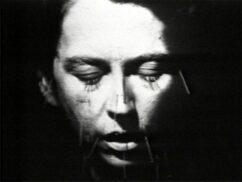
The image is an extract from The Birds (1963), depicting Melanie Daniels (Tippi Hedren) visiting Bodega Bay to warn the school they may be in danger. The treatment of the figure, including the amplification of small gestures, is similar to the earlier Stations — a device perhaps mimicking and subverting Hitchock’s own voyeuristic framing and filming of women. Dean has replaced all of the footage of the birds with cut-away shots of a black screen, indicating that the menace here is not the birds.
The soundtrack combines ‘Berlin’ by Lou Reed (1976) with the introduction to ‘Memory of a Free Festival’ by David Bowie (1969) mixed with ‘Sensitive’ by the Field Mice (1989). The Field Mice lyrics, “We all need to feel safe, then that’s taken away, sometimes I want to return”, suggest a child’s yearning to return to the safety of its mother’s arms. Later in the track they sing, “You do risk being crucified, crucified by those you are unlike,” in this context clearly intended as a reference to Jesus’ death. The layering of the different musical tracks produces a discordant affect of heightened tension and foreboding. This is reinforced by Hitchcock’s (or is it Dean’s?) editing: after each cut away shot, the camera moves in closer to Hedren’s face, augmenting her rising panic.
My Mum (V2-Sensitive) had a life before Stations of the Cross, and precedes many of the other works, making us question its inclusion here. Is Dean commenting on his own relationship to his late mother? Is there something in what we know of Hedren’s off-screen treatment and alleged abuse by Hitchcock that is significant? Writing in Artforum, Rachel Withers comments on Dean’s appropriation of an image of Tippi Hedren in an earlier work, observing that she “becomes a surrogate for the artist in a nuanced and moving moment of crossgender identification.” This particular work may invite us to imagine ourselves in the role of Jesus and of Mary, in the child separated from its mother, and in the mother fearful for the loss of her child. In the context of the COVID-19 outbreak, such fears and separations are commonplace, as is the yearning to return to a time before it all began.
The Fifth Station: Simon of Cyrene helps Jesus carry the cross
John Dean, postman & Communication Workers Union rep, Truro
A reading from a commentary by James E. Kiefer:
As Jesus was carrying his cross out of Jerusalem to the place of execution, a man named Simon of Cyrene was coming in, and the soldiers compelled him to carry the cross of Jesus. (The Greek word Angareuo, here used for ‘compel’, is a technical one, perhaps better translated ‘impress’, and referring to the legal right of a soldier to require a provincial to carry his gear one mile for him. The word occurs in the New Testament only here and in the Sermon on the Mount: ‘if anyone strikes you on the right cheek, turn the other also; and if anyone wants to sue you and take your coat, give your cloak as well; and if anyone forces you to go one mile, go also the second mile’.) Mark calls Simon ‘the father of Alexander and Rufus’ without further explanation, apparently taking it for granted that his readers would all know who Rufus and Alexander are. The Christian writer Papias (died around 130) tells us that Mark originally wrote his Gospel for the Christian community in Rome. This suggests that Alexander and Rufus were well known to, and probably part of, the Christian congregation in Rome. Very possibly their father Simon had himself become a Christian, though this must remain conjecture.
Golden Rehearsal
The theme of abandoned child is picked up again in Golden Rehearsal, which appropriates a clip from John Cassavetes film Gloria (1980), in which a young boy’s family is killed by the mob. Their neighbour Gloria becomes his reluctant guardian and the pair go on the run in New York. In this extract, Gloria is shown carrying the small boy on her shoulder as he sleeps — a direct allusion to Simon of Cyrene carrying Jesus’ Cross. The footage is looped and layered multiple times, so that it becomes increasingly illegible.
The soundtrack is from the Beatles’ Get Back sessions recorded live at Twickenham Studios in 1969, shortly before the band broke up. Members of the band can be heard joking and laughing while Paul McCartney rehearses his new composition ‘Golden Slumbers’, in which the lines “Once there was a way to get back homeward” and “I will sing a lullaby” assume great poignancy. At the very end, McCartney sings the first line of ‘Carry That Weight’: “Boy, you gotta carry that weight a long time”.
Images of death, abandonment, fear and loss combined with protectiveness, tenderness and support run through this work. The lyrics suggest sleep (or death?) as a way to get back homeward (to heaven?), and reference both the physical weight of the cross as well as the weight of the sins that Jesus bears on the cross. The camera stays zoomed in on Gloria’s face, so that she appears almost still, although it is clear that she is actually moving nervously through a busy cityscape. Similarly, the audio track focuses on McCartney’s playing, even through it is clear that there is lots of activity going on around him. Once again, Dean seems to be drawing attention to a still point in the turning world.
The Sixth Station: Veronica wipes the face of Jesus
Patricia Ellis, Course Leader, MA Fine Art, UAL Chelsea College of Arts
A reading from The Innocents Abroad, by Mark Twain:
We were standing in a narrow street, by the Tower of Antonio. “On these stones that are crumbling away,” the guide said, “the Saviour sat and rested before taking up the cross. This is the beginning of the Sorrowful Way, or the Way of Grief.” The party took note of the sacred spot, and moved on. We passed under the “Ecce Homo Arch,” and saw the very window from which Pilate’s wife warned her husband to have nothing to do with the persecution of the Just Man. This window is in an excellent state of preservation, considering its great age. They showed us where Jesus rested the second time, and where the mob refused to give him up, and said, “Let his blood be upon our heads, and upon our children’s children forever.” The French Catholics are building a church on this spot, and with their usual veneration for historical relics, are incorporating into the new such scraps of ancient walls as they have found there. Further on, we saw the spot where the fainting Saviour fell under the weight of his cross. A great granite column of some ancient temple lay there at the time, and the heavy cross struck it such a blow that it broke in two in the middle. Such was the guide’s story when he halted us before the broken column.
We crossed a street, and came presently to the former residence of St. Veronica. When the Saviour passed there, she came out, full of womanly compassion, and spoke pitying words to him, undaunted by the hootings and the threatenings of the mob, and wiped the perspiration from his face with her handkerchief. We had heard so much of St. Veronica, and seen her picture by so many masters, that it was like meeting an old friend unexpectedly to come upon her ancient home in Jerusalem. The strangest thing about the incident that has made her name so famous, is, that when she wiped the perspiration away, the print of the Saviour’s face remained upon the handkerchief, a perfect portrait, and so remains unto this day. We knew this, because we saw this handkerchief in a cathedral in Paris, in another in Spain, and in two others in Italy. In the Milan cathedral it costs five francs to see it, and at St. Peter’s, at Rome, it is almost impossible to see it at any price. No tradition is so amply verified as this of St. Veronica and her handkerchief.
At the next corner we saw a deep indention in the hard stone masonry of the corner of a house, but might have gone heedlessly by it but that the guide said it was made by the elbow of the Saviour, who stumbled here and fell. Presently we came to just such another indention in a stone wall. The guide said the Saviour fell here, also, and made this depression with his elbow. There were other places where the Lord fell, and others where he rested; but one of the most curious landmarks of ancient history we found on this morning walk through the crooked lanes that lead toward Calvary, was a certain stone built into a house—a stone that was so seamed and scarred that it bore a sort of grotesque resemblance to the human face. The projections that answered for cheeks were worn smooth by the passionate kisses of generations of pilgrims from distant lands. We asked “Why?” The guide said it was because this was one of “the very stones of Jerusalem” that Christ mentioned when he was reproved for permitting the people to cry “Hosannah!” when he made his memorable entry into the city upon an ass. One of the pilgrims said, “But there is no evidence that the stones did cry out—Christ said that if the people stopped from shouting Hosannah, the very stones would do it.” The guide was perfectly serene. He said, calmly, “This is one of the stones that would have cried out.”
The Veil of Veronica (offset Halo)
This work appropriates a short extract from This Gun for Hire (1942) directed by Frank Tuttle and starring Veronica Lake. Dean has slowed down, overlaid and offset two identical layers of the same scene that portrays Veronica Lake’s character performing a magic trick with a large fan made of feathers. The soundtrack to the work is provided by the 1997 single ‘Halo’ by the band Texas. Dean has EQd the sound to remove the vocals (although their echo remains), the guitars and the drums, thereby bringing the harmonic undertones of the orchestration to the surface. The resulting work has a mesmeric quality that is heavy with allusion. At times, the feathered fan produces a veil that obscures the figure of Veronica Lake, but which also connotes angelic wings. The pseudonymous title of the work alludes to the 1st century Saint Veronica who, according to legend, offered Jesus her veil to wipe his forehead. Jesus accepted her offering and, after using the veil, handed it back to Veronica with the image of his face miraculously impressed upon it. In some medieval traditions, effigies of the face of Christ are referred to as ‘Veronicas’.
These religious allusions are extended by the title and lyrics (albeit removed) of the audio track ‘Halo’, which also refer to the destructive lure of super-stardom and seem to echo the life of Veronica Lake, who was burnt by her own success and struggled with mental illness and alcoholism after the decline of her acting career. She veils or removes herself from the frame, as if to leave or transcend the external world, perhaps another oblique prefiguring of Jesus’ death or a comment on its efficacy. The faith of Saint Veronica is juxtaposed with the uncertainty and demise of the worldly Veronica, maybe a tacit acknowledgment of our human longing for proof of something higher than our own being in which to believe. And the image of the face of Christ left imprinted on the veil of Veronica questions the proofs upon which we base our knowledge of the death and resurrection of Jesus. Within these strange times, themes of immanence and transcendence, faith and doubt are amplified.
The Seventh Station: Jesus falls the second time
Rotimi Akinsete, author, therapist, & UAL Associate Dean of Students
A reading of Bonnie ‘Prince’ Billy’s ‘I See A Darkness’, by Will Oldham
Well you’re my friend
(It’s what you told me)
And can you see
(What’s inside of me)
Many times
We’ve been out drinking
And many times
We’ve shared our thoughts
But did you ever, ever notice
The kind of thoughts I got
Well you know I have a love
A love for everyone I know
And you know I have a drive
To live I won’t let go
But can you see its opposition
Comes a-rising up sometimes
That it’s dreadful anti position
Comes blacking in my mind
And that I see a darkness
And that I see a darkness
And that I see a darkness
And that I see a darkness
And did you know how much I love you
Is a hope that somehow you
Can save me from this darkness
Well I hope that someday, buddy
We have peace in our lives
Together or apart
Alone or with our wives
That we can stop our whoring
And pull the smiles inside
And light it up forever
And never go to sleep
My best unbeaten brother
This isn’t all I see
Oh no I see a darkness
Oh no I see a darkness
Oh no I see a darkness
Oh no I see a darkness
And did you know how much I love you
Is a hope that somehow you
Can save me from this darkness
A Minor Place
This work is constructed from a series of asynchronous loops from Wendy and Lucy by Kelly Reichardt, in which Michelle Williams (also known for her portrayal of the ultimate tragic screen siren, Marilyn Monroe) depicts a young woman whose life is progressively derailed through ill-fortune and dire economic decisions, resulting in separation from her beloved dog Lucy. She is shown sitting still and huddled, with her head covered so that her appearance becomes that of an androgynous homeless beggar. In our present situation, her figure invites identification with the poor and vulnerable who are disproportionally affected by the impact of COVID-19.
A moving camera shot through a forest is superimposed over the top of this, perhaps symbolic of the unconscious realm or impending threat, and the film credits ‘directed by Kelly Reichardt’ appear fleetingly in reverse. The drone like music, remixed from the film’s Will Oldham soundtrack, augments the darkness in the work and provides its title, which is borrowed from another Oldham song ‘A Minor Place’ (1999). Again, Dean uses the film’s credits as a device to reflect on Jesus falling. We are still given the privilege of knowing who is in control, but with the credits reversed, it is less clear. There is a sense in which perspective (of the victim and the viewer) is being lost as the Good Friday narrative draws closer to its climax and Jesus falls the second time.
The Eighth Station: Jesus meets the women of Jerusalem
Laura Jacobs, artist & UAL Central Saint Martins alumna
A reading from the Jewish Enyclopedia of 1906:
[Emanuel Deutsch’s] famous essay on the Talmud [the basis for all codes of Jewish law] in the “Quarterly Review” for October 1867… created probably a greater sensation than any other review article in England dealing with a purely literary subject, and caused that number of the “Quarterly” to be repeatedly reprinted. The article itself was translated into several languages, and contributed to create an interest in the Talmud wherever the essay was read. Though there was little that was new in the facts adduced—the literary history being derived from Wolf and the wise and witty sayings from Dukes—yet the skill with which the pertinent topics were grouped, the brilliancy of the style, and the underlying enthusiasm of the writer made it a striking performance. Some of its effect was due to the implied suggestion that the key to the life of the founder of Christianity was to be sought for in the surrounding ideas in Palestine. The renewed attention given to the Talmud in Christian circles, at any rate in England, was undoubtedly due to the article. The ambition of Deutsch’s life to produce a more exhaustive work on the Talmud was thus shadowed forth; but the failure of his health compelled him to abandon the project.
A reading from Emanuel Deutsch’s essay on The Talmud:
[In Jewish law,] The care taken of human life was extreme indeed. The judges of capital offences had to fast all day, nor was the sentence executed on the day of the verdict, but it was once more subjected to scrutiny by the Sanhedrin the next day. Even to the last some favourable circumstance that might turn the scale in the prisoner’s favour was looked for. The place of execution was at some distance from the Court, in order that time might be given to a witness or the accused himself for naming any fresh fact in his favour. A man was stationed at the entrance to the Court, with a flag in his hand, and at some distance another man, on horseback, was stationed, in order to stop the execution instantly if any favourable circumstance should still come to light. The culprit himself was allowed to stop four or five times, and to be brought back before the judges, if he had still something to urge in his defence. Before him marched a herald, crying, “The man N. N., son of N. N., is being led to execution for having committed such and such a crime ; such and such are the witnesses against him; whosoever knows aught to his favour, let him come and proclaim it.” Ten yards from the place of execution they said to him, “Confess thy sins; every one who confesses has part in the world to come ; for thus it is written of Achan, to whom Joshua said, My son, give now glory to the God of Israel.” If he “could not” offer any formal confession, he need only say, “May my death be a redemption for all my sins.” To the last the culprit was supported by marks of profound and awful sympathy. The ladies of Jerusalem formed a society which provided a beverage of mixed myrrh and vinegar, that, like an opiate, benumbed the man when he was being carried to execution.
Daughters of Jerusalem
This work appropriates footage from the closing sequence of the Israeli film Karov La Bayit (Close To Home) (2005) directed by Vardit Bilu and Dalia Hager. The film focuses on two 18-year-old Israeli girls who are thrown together as they are assigned to a patrol in Jerusalem as part of their compulsory military service. Their job is to stop Palestinian passers-by, to ask for their identity cards, and to write down their details on special forms. The sampled clip follows an altercation that has gone wrong, resulting in a Palestinian man being beaten up and possibly killed. The women are shown riding two-up on a motorbike, with the camera cropped in close on their faces and the footage slowed down. The speed of the original footage is apparent from the blurred landscape moving behind them creating the impression of still figures locked in a bewildering and disorienting world. The women’s faces look, in the same instant, guilty, defiant and numb as they start to realise they have become witnesses to a murder.
The image is in dialogue with the soundtrack — a remixed sample of ‘Lovely Rita’ by the Beatles in which the words “Lovely Rita meter maid” are repeated over and over again. The original lyric continues “In her cap she looked much older, and a bag across her shoulder, made her look like a little like a military man”, although the song may also be understood here as a reference to St Rita, also featured in the 13th Station.
The compassionate view of the two young women is complicated by their status as border guards in a contested territory — bringing to mind the borders that have been locked in response to the pandemic, and the possible future introduction of immunity passports. Historically, the ‘daughters of Jerusalem’ may be identified with a sorority of women who offered narcotic drinks to condemned men as an act of charity to ease the pain of their deaths. It was this ‘wine mixed with myrrh (or gall)’ that Jesus refused to drink on his way to be crucified.
The Ninth Station: Jesus falls the third time
Erika Winstone, artist, Fine Art lecturer, & Camberwell College of Arts alumna
A reading from ‘Through the Eyes of Angels, Cowboys, and Christians: A tribute to Wim Wenders, and an appreciation of his films’, by Jeffrey Overstreet
When you watch a film by Wim Wenders, you’re asked to consider the world through starkly different perspectives. Each of his narratives focus on people whose views are limited, and who need to be reconciled into a more complete understanding. In his beloved, Cannes-award-winning masterpiece — Wings of Desire (1987) — Wenders follows angels on their daily beat through the troubled streets of Berlin before the wall was torn down. There, an angel named Damiel (Bruno Ganz) wanders and listens to the needy thoughts of the despairing citizens, and he marvels at the faith of wide-eyed children. Damiel longs to know the joys of sensory experience. And when he encounters a human being — a beautiful circus trapeze performer named Marion (Solveig Dommartin) who longs for communion with a kindred spirit — he finds the provocation to “take the plunge” into human form and pursue her. As her guardian angel, he offers almost imperceptible spiritual comfort. As his muse, Marion lures him to embrace the mystery of human experience, so that even the simple joy of holding a hot cup of coffee on a cold morning inspires him to reverence and wonder, revealing the sacred in the ordinary… By tuning our attention to the perspective of angels, viewers often find renewed appreciation for the incarnational nature of creation, and greater apprehension of God’s love in the highs and lows of daily life. Those rewards come from attentive viewing, but also through patient filmmaking, and Wenders has learned to be watchful and open to surprises in the course of a project. In a recent issue of MovieMaker, he volunteered a list of 50 tips for filmmakers. One in particular stands out: “Films can reveal the invisible, but you have to be willing to let it show.” I asked Wenders what he meant by that during my recent interview with him for Christianity Today. “This is one of the amazing achievements of film,” he assured me, “that they can reveal something that you can’t actually see. When I started out as a painter, I strictly believed in the visible, and that the visible was it. And in the course of making movies, I realized that something I hadn’t actually seen in front of my camera was then there in the movie.” This was especially true during the filming of Wings of Desire. While Wenders was, at the time, distancing himself from his religious upbringing, he found that filming from the perspective of imaginary angels caused him to discover and capture wondrous and meaningful things that he had never planned. “I never really thought that a film could deal with anything metaphysical…. And when we finished it, I thought, ‘How much help can I possibly get?’ It felt like I had almost made the film completely unconsciously, and that the angels that I had sort of ‘called’ had actually been there to help me.” The audience’s enthusiasm for Wings of Desire around the world amazed Wenders, and the experience of making the film and observing its influence played a part in renewing his Christian faith. “There was no explanation for the powerful impact that these figures had on audiences,” he recalls. “What I had taken for a metaphor had, sort of miraculously, materialized. So I came to terms with the fact that the invisible was powerfully working in movies. I just had to let it happen. You can’t make it happen. I don’t think you can consciously evoke that. At least, I didn’t.”
In Freundschaft
In Freundschaft or ‘In friendship’ combines sound from the beginning and image from the end of Wim Wenders’ film The American Friend (1977), based on two novels by Patricia Highsmith, Ripley Underground and Ripley’s Game. In the film, picture framer Jonathan Zimmerman (Bruno Ganz) believes that he is critically ill, and is coerced into becoming a hitman in order to provide for his wife and child. The audio from the beginning of the film depicts a conversation between Tom Ripley (Dennis Hopper) and a painter discussing a forged art deal. The footage at the end shows Zimmerman lying dead in a car next to his wife Marianne (Liza Kreuzer). The scene is watched over by the (supposedly dead) painter who walks away from the camera as the end credits start to roll. The image and sound are looped, layered and time-shifted three times in reference to Jesus falling, becoming increasingly incoherent and disconcerting in the process. Whereas in previous works the credits have provided some sense of order, perhaps even implying a divine plan, here they become illegible through their repetition.
This is perhaps the darkest and certainly the most opaque of Dean’s Stations of the Cross. The audio begins with the sound of a train whistling and a man singing to himself, “I’ve been doing some low down travelling, God knows I have” with tense music playing in the background. Distorted snippets of the conversation including, “I think this is serious”, “I’ve been waiting for you” and references to dirty-money art deals pop out, amplifying the sense of threat. The interwoven themes of money and death reinforce the extent to which a health crisis always inevitably becomes a financial crisis, and the role in which ‘thirty pieces of silver’ played in the death of Jesus.
In Freundschaft refers back to two earlier works included in Dean’s first solo show at City Racing in 1996: Nothing To Fear (The American Friend +-12) and I’m Confused (The American Friend +-50%). It is also the title of a 1977 work by Stockhausen, in which the four parameters of pitch, duration, dynamics, and timbre are all determined by a musical formula, the basic form of which is presented at the outset of the work. In returning to The American Friend as source material, Dean continues to experiment with its formal parameters in ways informed by serial and minimal composers and the borrowed title of the work seems to flag this up.
The Tenth Station: Jesus is stripped of his garments
Suzanne Smith, Respiratory Nurse, Wirral University Teaching Hospital, Arrowe Park
A reading from Psalm 22
I am poured out like water,
and all my bones are out of joint;
my heart is like wax;
it is melted within my breast;
my mouth is dried up like a potsherd,
and my tongue sticks to my jaws;
you lay me in the dust of death.
For dogs are all around me;
a company of evildoers encircles me.
My hands and feet have shrivelled;
I can count all my bones.
They stare and gloat over me;
they divide my clothes among themselves,
and for my clothing they cast lots.
God Is Not Mocked
This work appropriates the opening sequence from Kenneth Anger’s 6-minute film Puce Moment (1949), which begins with the film credits before cutting to a close up shot of vividly coloured flapper dresses being danced off a clothes rack to music.
In the context of the Stations, the removal of the dresses from the rack is an allusion to Jesus being stripped of his garments. Dean has looped and layered the footage, then overlaid it with a red-blue filter in reference to the title of Anger’s film and perhaps also to the purple robe and ‘royal’ crown of thorns placed on Jesus at this point in the narrative. The soundtrack appropriates a lyric from Neil Young’s ‘Cowgirl in the Sand’, “Purple words on a grey background”, which is repeated over and over and then echoed and reechoed, pointing attention back to Anger’s title and to the opening credits, in particular the pun in his name. ‘Anger’ could be understood as a comment on the attitude of the perpetrators who strip Jesus or, along with Dean’s title, God Is Not Mocked (a reference to Galatians 6:7), a riposte to Kenneth Anger’s own occult appropriation of Judeo-Christian imagery in his later works.
The Eleventh Station: Jesus is nailed to the cross
Cecily Cleeve
A reading from Psalm 22
My God, my God, why have you forsaken me?
Why are you so far from helping me, from the words of my groaning?
O my God, I cry by day, but you do not answer;
and by night, but find no rest.
Yet you are holy,
enthroned on the praises of Israel.
In you our ancestors trusted;
they trusted, and you delivered them.
To you they cried, and were saved;
in you they trusted, and were not put to shame.
But I am a worm, and not human;
scorned by others, and despised by the people.
All who see me mock at me;
they make mouths at me, they shake their heads;
‘Commit your cause to the Lord; let him deliver—
let him rescue the one in whom he delights!’
Yet it was you who took me from the womb;
you kept me safe on my mother’s breast.
On you I was cast from my birth,
and since my mother bore me you have been my God.
Do not be far from me,
for trouble is near
and there is no one to help.
My God, My God, Why Have You Forsaken Me?
This title references the last words Jesus spoke on the cross before he died, themselves appropriated from Psalm 22. At this moment in the narrative, Dean resists incorporating a figure, to signal his avoidance of representing the death of God. Instead, he appropriates the title sequence of Sauve Qui Peut (La Vie) aka Slow Motion aka Every Man For Himself (1980), by Jean Luc Godard. The puns in the text ‘Un film compose par Jean Luc Godard, Sauve Qui Peut (La Vie), Copyright 1979 Sonimage’ are explicit, referencing God in the director’s name and the image of the Son in the copyright notice, which is flagrantly flouted.
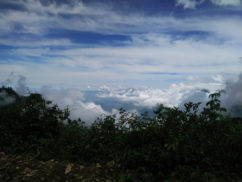
The credits roll over a vast expanse of cloud filled sky, suggestive of Jesus’ view from the cross, and a visual reference back to the composition of the first Station, indicating that Jesus’ death sentence has now been executed. The soundtrack is a short looped extract from ‘Love Don’t Live Here Anymore’ by Rose Royce, which includes a rising and falling string section layered over a repetitive synthetic beat, producing in this context the effect of a nail being hammered into wood.
The Twelth Station: Jesus dies on the cross
William Whitcombe, UAL Lead Chaplain & Priest in Ordinary to HM The Queen
A reading from the Gospel according to Luke:
It was now about noon, and darkness came over the whole land until three in the afternoon, while the sun’s light failed; and the curtain of the temple was torn in two. Then Jesus, crying with a loud voice, said, ‘Father, into your hands I commend my spirit.’ Having said this, he breathed his last. When the centurion saw what had taken place, he praised God and said, ‘Certainly this man was innocent.’ And when all the crowds who had gathered there for this spectacle saw what had taken place, they returned home, beating their breasts. But all his acquaintances, including the women who had followed him from Galilee, stood at a distance, watching these things.
The Christmas Tree
Jesus’ death is perhaps the hardest point in the narrative to depict visually. Again, Dean resists figuration and offers up a silent video loop of footage from the start of a drag race. Modern drag races are started electronically by a system known as a ‘Christmas tree’, consisting of a column of seven lights for each lane, as well as a set of light beams across the track itself. Dean has overlaid and offset the same clip using a difference filter, so that where the two images are the same, the image appears dark; only the variation between the two layers is illuminated revealing a changing light-sequence of the Christmas tree and the speeding cars. The Christmas tree introduces a deliberate pun for the Cross of Christ, placing it at the centre of the action, and the moments of darkness created by the difference filter allude to the ‘darkness that came over the whole land’ when Jesus died.
Whereas in most of the preceding video Stations, Dean has used footage shot through a moving camera that remains focused on a still central figure, in this work he inverts the construct, making use of footage from a locked camera shot of a subject moving at speed. Is Dean suggesting that Jesus’ death inverts the world-order as we know it; that the ‘still point’ which, until recently was acted upon by the ‘turning-world’, now undergoes a change in state and starts to exert its own influence upon that same world?
The Thirteenth Station: Jesus is taken down from the cross
Jatun Risba, artist & UAL Central Saint Martins MA Art & Science student
A reading from Yves Klein’s prayer accompanying his ex-voto to St Rita of Cascia:
1961, Feb. Y.K.
– The BLUE, the GOLD, the PINK, the IMMATERIAL, the VOID, the architecture of the air, the urban planning of the air, the air-conditioning of the great geographic spaces for a return to a human life in nature, in the Paradisiac state of legend. The three fine gold ingots are the product of the sale of the first 4 ZONES OF IMMATERIAL PICTORIAL SENSIBILITY.
– To Almighty God Father in the name of the Son, Jesus Christ and in the name of His Son Jesus Christ and in the name of the Holy Spirit and of the Holy Virgin Mary. Through St. Rita da Cascia, under her care and protection, all my infinite gratitude. Thank you. Y.K.
– St. Rita da Cascia, please intercede with Almighty God the Father that he may always grant me in the name of His Son Jesus Christ and the name of the Holy Spirit and of the Holy Virgin Mary the favour of inhabiting my works and that may become ever more beautiful, and also the favour that I may continually and regularly discover ever new and lovelier things in art even if alas I may not always be worthy to be a tool for the construction and creation of Great Beauty. Please let everything that comes out of me be Beautiful. Amen, Y.K.
– Under the earthly care of St. Rita da Cascia: the Pictorial Sensibility, the monochromes, the I.K.B.s, the sponge sculptures, the immaterial, the static anthropometrical imprints, positive, negative and in movement, the shrouds, the Fountains of Fire, of water and Fire – the architecture of the air, the urbanism of the air, the air-conditioning of geographic spaces thus transformed into constant Gardens of Eden rediscovered on the surface of our globe – the Void.
– The theatre of the Void – all the particular variations in connection with my work – the Cosmogonies – my Blue sky – all my theories in general – May my enemies become my friends, and if that is impossible, may nothing which they might attempt againstme ever be of any avail or ever affect me in any way whatever – Make me, and all my works, totally invulnerable. Amen.
– May all my works at Glesenkirchen always be Beautiful, more and more beautiful, and let them be recognized as such more and more and as quickly as possible. May the Fountain of Fire and walls of Fire, be executed by me in the Opera square at Gelsenkirchen without delay – May my Krefeld Exhibition be the greatest success of the century and be recognized by all.
– St. Rita of Cascia, Saint of impossible and desperate causes, thanks be to you for all powerful, decisive and marvellous help which you have granted me so far – I thank you with all my heart. Even if I am not personally worthy to receive it grant me aid again and always in my art and always protect everything that I have created so that it may, despite me, be of Great Beauty for ever. Y.K.
The Bearer
In this work, Dean superimposes a photograph of Sister Andreina, Mother Superior at the Augustinian Convent of Saint Rita of Cascia, over footage from Leni Riefenstahl’s Nazi propaganda film, Olympia (1938). Sister Andreina is shown holding an ex-voto made by Yves Klein that was left at the monastery during a pilgrimage to Cascia. Saint Rita is known as the patron saint of lost causes and was a favourite object of Klein’s devotion and ritualistic interest.
The footage from Olympia depicts athletes diving from a springboard with arms outstretched, generating a direct visual allusion to Klein’s Leap into the Void photograph, and to the crucifixion. A progression of pink, blue and gold filters are applied to the video, in reference to the pigments Klein placed in his ex-voto, and also corresponding to the red and amber colours of the Christmas Tree lights in the preceding work. This visual correspondence, taken together with the fact that The Christmas Tree and The Bearer are the only two silent Stations, suggests that they are to be considered together. If The Christmas Tree suggests a change in world order achieved through the crucifixion, then a microcosm of this transformation is revealed in the events that followed the making of Klein’s Leap into the Void photograph. In a strange coincidence, the house outside Paris that he leapt from in making this work was later demolished to make way for a church dedicated to Saint Rita. An action performed ‘in the order of signs’ is completed through the transformation of the physical world order.
The Fourteenth Station: Jesus is laid in the tomb
Rylie Goodchild, artist & UAL Central Saint Martins BA Fine Art student
A Reading from John Richardson’s eulogy for Andy Warhol, given on the occasion of his memorial service at St. Patrick’s Cathedral in New York City, April 1, 1987
Besides celebrating Andy Warhol as the quintessential artist of his time and place – the artist who held the most revealing mirror up to his generation – I’d like to recall a side of his character that he hid from all but his closest friends: his spiritual side. Those of you who knew him in circumstances that were the antithesis of spiritual may be surprised that such a side existed. But exist it did, and it’s the key to the artist’s psyche. Never forget that Andy was born into a fervently Catholic family and brought up in the fervently Catholic Ruska Dolina, the Ruthenian section of Pittsburgh. As a youth, he was withdrawn and reclusive, devout and celibate; and beneath the disingenuous public mask that is how he at the heart remained. Thanks largely to the example of his adored mother, Julia, Andy never lost the habit of going to mass more often than was obligatory. As fellow parishioners will remember, he made a point of dropping in on his local church, St. Vincent Ferrer, several days a week until shortly before he died. Although Andy was perceived – with some justice – as a passive observer who never imposed his beliefs on other people, he could on occasion be an effective proselytizer. To my certain knowledge, he was responsible for at least one conversion. He took considerable pride in financing a nephew’s studies for the priesthood. And as you have doubtless read on your mass cards, he regularly helped out at a shelter serving meals to the homeless and the hungry. Trust Andy to have kept these activities very, very dark. The knowledge of this secret piety inevitably changes our perception of an artist who fooled the world into believing that his only obsessions were money, fame, glamor, and that he was cool to the point of callousness. Never take Andy at face value. The callous observer was in fact a recording angel. And Andy’s detachment – the distance he established between the world and himself – was above all a matter of innocence and of art. Isn’t an artist usually obliged to step back from things? In his impregnable innocence and humility Andy always struck me as a yurodstvo – one of those saintly simpletons who haunt Russian fiction and Slavic villages, such as Mikova in Ruthenia, whence the Warhols stemmed. Hence his peculiar, passive power over people; his ability to remain uncorrupted, no matter what activities he chose to film, tape, or scrutinize. The saintly simpleton side likewise explains Andy’s ever-increasing obsession with folklore and mysticism. He became more and more like a medieval alchemist searching – not so much for the philosopher’s stone as for the elixir of youth. If in the sixties some of the hangers-on at The Factory were hell-bent on destroying themselves, Andy was not to blame. He did what he could to help, but nothing in the world was going to deter those lemmings from their fate. In any case Andy was not cut out to be his brother’s keeper. That would hardly have been compatible with the existent detachment which was his special gift. However, Andy did feel compassion, and he did, in his Prince Myshkin way, save many of his entourage from burnout. Though ever in his thoughts, Andy’s religion didn’t surface in his work until two or three Christmases ago, when he embarked on his series of Last Suppers, many of them inspired by a cheap mock – up of Leonardo’s masterpiece he bought on Times Square. Andy’s use of a pop concept to energize sacred subjects constitutes a major breakthrough in religious art. He even managed to give a slogan like “Jesus Saves” an uncanny new urgency. And how awesomely prophetic is Andy’s painting – one of his very last – which announces: “Heaven and Hell are just one breath away!”
Cartoon Burial
In Cartoon Burial, Dean layers Raphael’s study for the Pala Baglione (also known as The Deposition or The Entombment) over a Googlemaps image of Jerusalem. For the first time, the work is explicitly located in a real person, in a specific place, at a precise moment in history. The soundtrack is provided by ‘Come Down To Us’ by South London sound-collagist, Burial.
The image is originally unclear. A close up of human limbs is faintly discernible, which becomes clearer as the drawing gradually descends within the frame. The audio track begins with the sample of a woman’s voice saying, “Excuse me, I’m lost” and then builds through layer upon layer of multi-textured samples, including voice snippets repeating phrases such as “You are not alone” and, “Don’t be afraid to step into the unknown”. The initial illegibility of the image becomes clearer as the work progresses as if to answer the vocal snippets asking, “Who are you? Why did you come to me?” In some sections, the track sounds almost like contemporary worship music.
The Burial track ends with an extract from a speech by transgender filmmaker Lana Wachowski: “Without examples, without models I began to believe voices in my head, that I am a freak, that I am broken, that there is something wrong with me, that I will never be lovable. Years later, I find the courage to admit that I am transgender, and that does not mean that I am unlovable… This world that we imagine in this room might be used to gain access to other rooms, other worlds, previously unimaginable.” Its inclusion here could be understood as a political statement addressing current debates within the church over the role of gay clergy, and its treatment of the LGBT community, or a simple statement of inclusion addressed to those ‘in this room’ — that is, the viewers of the Stations of the Cross, watching online, alone and together.
The Fifteenth Station: Jesus rises from death

Phil Baines, designer & UAL Central Saint Martins Professor of Typography
‘This is only the second year since 1986 that I haven’t been able to design and print a Paschal candle design. The last time (2005) I was ill; this time the college was closed and there are no church services. This year’s candle would have been letterpress set and printed, and something like this: the first two lines from Alessandro Striggio’s motet Ecce Beatam Lucem of 1561 (Behold the blessed light; behold the everlasting goodness), prompted by UAL Chaplain Mark Dean, and the required phrases Alpha, Omega, and 2020. The required cross would have been made solely by the incense ‘pins’. The arrangement of the words follow the courses of bells 1, 4, and 6 during the ringing of Grandsire Minor.’
Here Comes The Sony (Rehearsal)
In this new fifteenth station, footage of dancers from Lizzi Kew Ross & Co. in an early rehearsal for Stations of the Resurrection is gradually overlaid with twelve rotating discs, each one produced by filming through the back of a translucent Sony lens cap, so that the logo remains visible in reverse. With the introduction of each new disc, another layer of looped sound is added. The track is fleetingly recognisable as the guitar riff from the opening bars to ‘Here Comes the Sun’ by the Beatles, although the original has been progressively extended so no two loops are the same duration. The discs rotate at different speeds, in sync to the soundtrack, changing hue as they cycle through the colour spectrum. As the music builds, the particular melody of ‘Here Comes the Sun’ is obscured, although never quite lost, as the sounds merge to create the effect of a peal of Easter bells. The twelve discs correspond to Jesus’ resurrection appearances in the New Testament and the sampled music from ‘Here Comes the Sun’ is a deliberate pun referencing the coming of The Son, which is further reinforced by the retention of the reversed Sony logo.
The first fourteen Stations contemplate the path that Jesus walked to Calvary on the day of his crucifixion. The fifteenth station has moved forwards in time three days to Jesus’ resurrection. A version of this work was first installed under the dome of St Paul’s Cathedral during Eastertide 2017, when it was realised as a twelve-monitor video and sound installation titled Here Comes the Sony: Stations of the Resurrection, and accompanied by a performance of Being Here by Lizzi Kew Ross & Co. The movement material focused on the repeated withdrawal and reconnection of the dancers to create a physical metaphor of presence and absence, connection and loss. In this rehearsal except, each dancer is carried or supported by the others in turn. They fold and unfold around each other. It is not clear who is acting on whom. They come together to form tableaux which are visually reminiscent of Käthe Kollwitz’ drawings and sculptures. Human bodies melt together, limbs draped over limbs, in the act of protecting, comforting and carrying each other. It is not clear where one body starts and another ends or whether it is one body or many that is being implied.
Watching this movement material again, in a season when touch is prohibited, delivers a poignant reminder of what has been lost: a time when the freedom to touch another person was taken for granted. On one level, the circles appearing over the dancers brings to mind the daily published infographics showing the spread of Coronavirus and its case fatality rates, a constant reminder of the danger associated with physical contact. The work also calls to mind one of the earliest resurrection appearances recorded in John’s Gospel: when Mary Magdalene first recognises Jesus, she reaches out to towards him, to which he replies, “touch me not” (Noli me Tangere). Jesus explains his refusal to be touched saying, “I have not yet ascended to the Father.” One possible interpretation is that Jesus is pointing Mary’s attention away from the physical act of resurrection and towards its spiritual meaning.
Within this framework, the rotating discs become symbolic of the wafer that the Priest distributes during the Eucharist and over which he prays the words, “this is my body, broken for you.” Jesus instituted the Eucharist at the Last Supper, the night before his death when he met with his disciples to celebrate the Passover Seder. At this meal, they would have recited the ten plagues visited on Pharaoh and his people, to force them to release the Israelites from slavery. Jesus is revealing to the disciples that the tenth plague, which resulted in the death of the first-born child, is about to be enacted on him. The incarnate God is not immune to the ravages of a plague or virus, but through his death, all people are saved from the slavery of sin.
The rotating discs, shot through a lens-cap, can also be interpreted as an eschatological metaphor that corresponds to Paul’s description of a resurrection life that is, at the same time, both realised and not yet realised; present now and yet still in the future: “For now we see through a glass, darkly; but then face to face: now I know in part; but then shall I know even as also I am known.” This partial ‘blindness’ co-exists with the acclamation of faith, “Here Comes the Son”. The New Testament looks towards a historical future, towards the redemption of the whole world, but from the angle of the fallen world and its history, that can only be expressed apocalyptically.
The theme of looking through a glass is reinforced towards the end of the fifteenth station, when the dancers move out of view and the camera focusses on a seam between two opaque glass windows. Until now, the dancers have been dancing in front (or on top) of this seam, which corresponds visually with the windscreen wipers in Station 1 that cut through Maria’s body. The abstracted architecture also resembles Station 2, where the astragals in the airport window form a cross. There is a sense of completion in the journey, achieved through the crucifixion.
The work invites discourse about the Christian journey of faith in which the church approaches Good Friday with the prior knowledge of the Resurrection: it lives with the knowledge that the victory has been won, and yet acknowledges that human beings still encounter the pain of death, darkness and separation in this life. In the meantime, the church is nourished by the sacraments and in particular the Eucharist — and reminded of its justification and salvation through observance of Lent and the celebration of Easter — through re-living the Via Crucis and the Via Lucis.
Commentaries courtesy Lucy Newman Cleeve, curator, producer and writer
Source material used in accordance with Copyright and Rights in Performances (Quotation and Parody) Regulations 2014 – for © acknowledgements and further information please follow the ‘about’ links under each video work.